Minimalist Muse

Minimalist style & the forever wardrobe

How to Build a Minimalist Closet That Still Feels Chic

2026-07-11

There’s a version of the minimalist closet that works, and a version that ends up as thirty grey items you’re mildly bored by. Both were built from the same advice. The difference comes down to three decisions made early — palette, fit, and what you allow yourself to keep.

Quick Answer: A minimalist closet stays chic when it’s built on two committed base neutrals plus one or two accents you genuinely love, every piece fits properly (which usually means budgeting for a tailor), and you keep only what pairs with at least three other things. Add one or two personal signatures — a great coat, a signature earring, a lip color — so restraint reads as a choice rather than as an absence.

How to Build a Minimalist Closet That Still Feels Chic

How Do You Choose a Palette and Actually Stick to It?

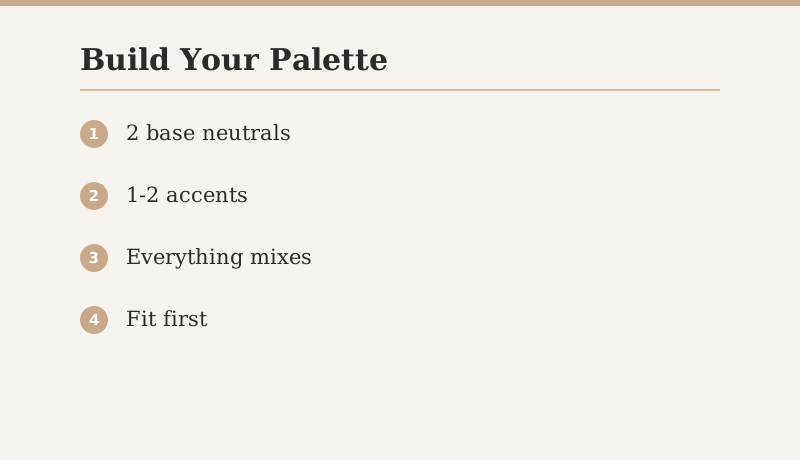
Pick two base neutrals and one or two accents. Write them down. Then every future purchase has to answer to that list.

Base pairs that work:

  • Black and cream — the highest-contrast option, sharp and urban
  • Navy and camel — softer, warmer, reads more classic
  • Charcoal and oatmeal — the quietest of the three, very forgiving
  • Black and grey — the most versatile for a wardrobe that leans casual

Then one or two accents — a green you reach for, a rust, a soft blue. Real preferences, not what’s fashionable this year.

Why two rather than three: a third base neutral means roughly half your pieces don’t quite work with the other half. Black, cream, navy, and grey sounds harmless and produces a closet where combinations fail. Two bases means everything goes with everything, which is the entire mechanism.

The commitment part matters more than the choice. Any of these palettes works. Switching between them every eighteen months is what leaves you with an incoherent closet full of individually nice things.

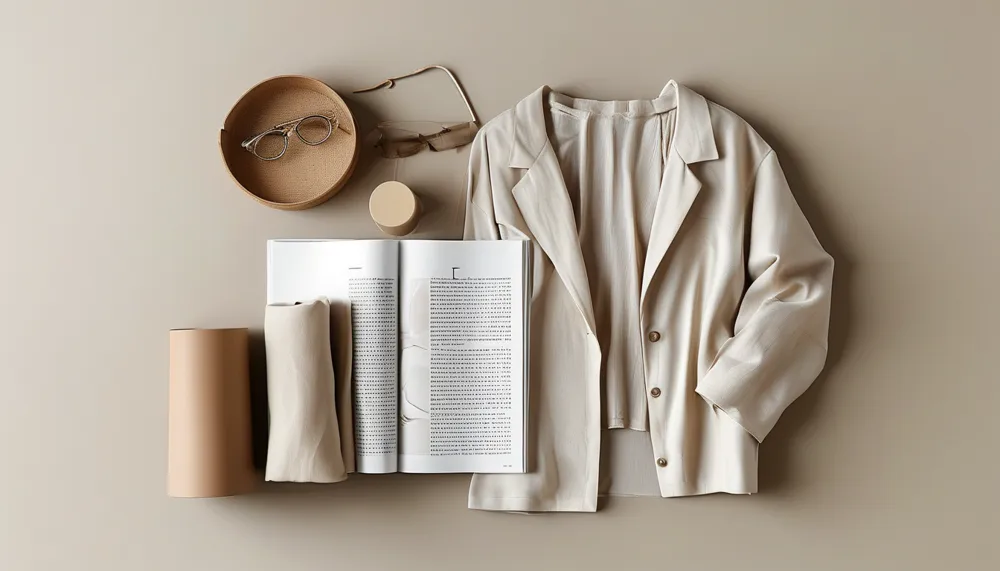
Styling flat lay

Why Is Fit the Whole Game?

Because when you strip away pattern and embellishment, fit is the only quality signal left.

A simple sweater in exactly your size reads as luxury precisely because nothing distracts from the cut. The same sweater a size too big reads as an old sweater. There’s no print to argue with the eye about it.

The four fit points that matter most:

  1. Shoulder seam — should sit at the edge of your shoulder. This is the hardest thing for a tailor to change, so buy for it
  2. Trouser break — where the hem meets the shoe. A slight break for straight legs, a graze for wide legs
  3. Sleeve length — ending at the wrist bone. On a jacket, showing a half-inch of shirt cuff
  4. Waist placement — seams sitting at your actual waist, not an inch above or below it

Budget for a tailor. Hemming trousers runs about $15–25, taking in a waist $20–30, shortening sleeves $25–40. That’s cheaper than one more almost-right purchase, and it’s the single highest-return spending in a minimal wardrobe.

The rule of thumb: buy for the shoulders and the widest measurement, then alter everything else.

Point detail

How Ruthless Should the Edit Be?

Ruthless once, then maintained. Pull everything out and hold each piece against four questions:

  1. Have I worn it in the last year? Not “would I” — did I
  2. Does it fit me today? Not the me of two years ago or a hypothetical future me
  3. Does it go with at least three other things I own? This is the one that catches the most pieces
  4. Do I actually like it, or do I just not dislike it? The neutral ones are the quiet clutter

Anything failing two or more goes. Anything failing question three specifically goes regardless of how nice it is on its own — an orphan piece is a piece you’ll never wear, no matter how good it looked in the store.

Then maintain with one-in-one-out. A new sweater displaces an old one. Without this, a carefully edited closet quietly refills over about eighteen months, and you do the whole exercise again.

A useful pause: wait 24 hours on anything unplanned. Most impulse purchases don’t survive a day of thinking about where they’d fit in the palette.

Myth vs Fact

Myth: A minimalist closet means owning as little as possible. Fact: It means owning only what works. Thirty-five pieces that all combine beats twenty that don’t — the count is an outcome, not a target.

Myth: Neutral colors are inherently more chic. Fact: Coherence is chic. A closet built entirely on olive, rust, and cream is just as minimal as a black-and-white one, and considerably more personal.

Myth: You need expensive pieces for this to work. Fact: Fit beats price. A mid-range trouser hemmed properly outperforms a designer one that doesn’t fit, every time and visibly.

Myth: Minimalism means no accessories or personality. Fact: The signature pieces are what stop it reading clinical. Restraint everywhere except one deliberate place is the actual formula.

Where Does Personality Fit In?

In one or two designated places, chosen deliberately.

A single sculptural earring worn daily. One great coat in a color nobody else has. A signature lip. A recognizable pair of boots. These are what turn a well-organized closet into a wardrobe that’s identifiably yours.

The rule is placement, not quantity. One signature per outfit, and it can be the same signature every day — repetition is what builds recognition. That’s how personal style works: people remember the woman in the green coat, not the woman with a different accessory each time.

Where to spend for signature effect: outerwear and shoes. They’re seen most, worn longest, and they’re the two categories where a distinctive choice reads as intentional rather than as noise.

Everything else stays quiet. A well-built capsule wardrobe is designed to let one or two things be interesting — the restraint isn’t the goal, it’s the setup.

Style guide

FAQ

How many colors should a minimalist wardrobe have?

Two base neutrals plus one or two accents — four total at most. Adding a third base neutral is the most common way a coherent closet quietly becomes an incoherent one.

What should I do with the clothes I edit out?

Sell the pieces with resale value, donate the rest, and be honest about the “maybe” pile. Anything that sits in a box unopened for six months was a no.

How long does it take to build one of these?

Eighteen months to two years if you’re replacing rather than adding all at once, which is the version that works. Buying a complete capsule in one weekend produces a shopping trip, not a wardrobe.

TL;DR:

  • Two base neutrals plus one or two real accents — commit and buy against the list
  • Fit is the only quality signal in a plain wardrobe; budget $15–40 per alteration
  • Edit against four questions, and drop anything that pairs with fewer than three things
  • Maintain with one-in-one-out or it refills within two years
  • Put personality in one or two designated places — usually outerwear and shoes
  • Coherence, not scarcity, is what makes it look chic

A chic minimalist closet is built, not bought overnight. Start with the palette, obsess over fit, keep only what earns its hanger, and leave one deliberate place to shine — the result feels calm, capable, and unmistakably yours.

Keep Reading

This article is for general styling and informational purposes only. Trends, sizing, availability and pricing may vary by brand and season.

← All articles