The Minimalist Wardrobe: 10 Pieces You'll Wear Forever
There’s a certain kind of woman whose outfits always look considered — never fussy, never trying too hard, somehow always right. Her closet isn’t bottomless. It’s about thirty items, ten of which do most of the work, and she stopped buying new ones years ago.
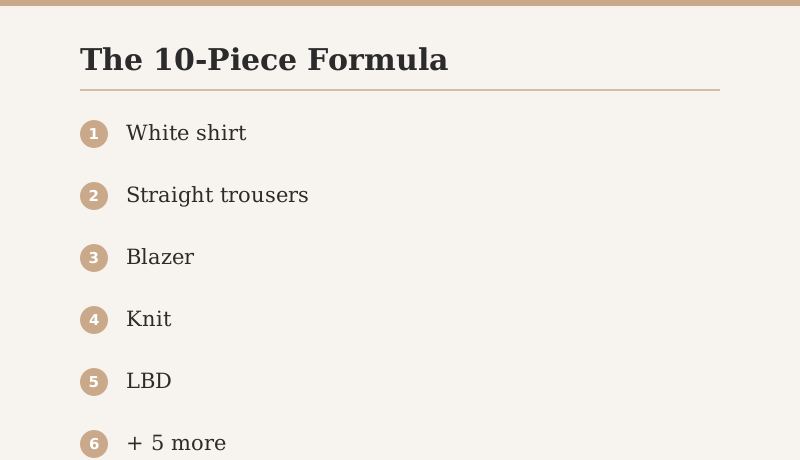
Quick Answer: Ten pieces form the backbone of a minimalist wardrobe: a white button-down, straight-leg trousers, a tailored blazer, a fine-knit crewneck, a little black dress, dark straight jeans, white leather sneakers, leather loafers, a structured tote, and a camel or black overcoat. Chosen in two neutrals, they produce well over fifty distinct outfits — and none of them are trend-dated.

What Are the Ten Pieces?
- White button-down shirt — cotton poplin, not stretch. Worn buttoned for work, half-tucked with jeans, open over a tank in summer
- Straight-leg trousers in black or navy — the piece that decides whether the wardrobe reads polished or casual
- Tailored blazer — one size up from fitted, so it layers over knitwear
- Cashmere or merino crewneck in oatmeal, grey, or navy — fine gauge, so it fits under the blazer
- Little black dress that skims rather than clings — the ninety-second solution to any invitation
- Dark-rinse straight jeans — dark enough to wear to dinner, structured enough to hold shape
- White leather sneakers — clean, minimal, replaced when they stop being white
- Classic leather loafers — the shoe that dresses up jeans and dresses down trousers
- A structured tote in a neutral leather — the one bag that carries a laptop and still looks intentional
- A camel or black overcoat — the piece that determines what everyone sees for five months of the year
Notice what isn’t here: nothing trend-driven, nothing seasonal beyond the coat, nothing you’ll look at in three years and wince.
Why Do These Ten Specifically?
Because each one connects to at least six of the others. That’s the actual selection criterion, and it’s stricter than “do I like it.”
The math: a piece that pairs with six others is worth roughly three times a piece that pairs with two, no matter what either costs. A white shirt works with the trousers, the jeans, the blazer, the loafers, the sneakers, and under the coat. A printed blouse works with maybe two things, and only in one mood.
The anchors do the heavy lifting. The white shirt, straight-leg trousers, blazer, and LBD are the four you reach for on days you have zero energy to think. They’re chosen precisely to be unremarkable, which is what makes them reliable.
Everything speaks the same language. Same palette, same level of formality, same weight class. When that’s true, getting dressed genuinely takes ninety seconds, because there’s no combination that fails.

How Do You Keep It From Looking Like a Uniform?
Texture, not print. This is the whole answer.
When the palette stays calm, texture becomes the thing that makes an outfit look expensive. A ribbed knit against smooth trousers. A slouchy leather tote against crisp poplin. A fine merino under a structured blazer. Same colors, visibly different surfaces.
The three moves that add interest without adding noise:
- Vary the fabric hands — pair something with surface (rib, boucle, suede) against something smooth
- Change the proportions — full tuck one day, half-tuck the next, sleeves pushed or down
- Add one accessory with intent — a single earring, a scarf, a belt. One, not three
What doesn’t work is adding a print “for variety.” A print in a neutral wardrobe is a guest that doesn’t know anyone at the party.

5 Mistakes Everyone Makes
- Buying all ten at once. A wardrobe assembled in a single weekend is a shopping trip, not an edit. Buy one piece at a time and wear it for a month before adding the next.
- Choosing three neutrals instead of two. Black, cream, navy, and grey means half your pieces don’t quite go with the other half. Pick two base neutrals and commit.
- Compromising on fit to get the piece. With nothing distracting, fit is the only quality signal. An almost-right blazer stays almost-right forever.
- Skipping the tailor. Twenty dollars of hemming makes a mid-priced trouser look considerably better than an expensive one off the rack.
- Treating “forever” as literal. White sneakers wear out. Cotton shirts thin. Forever means the style lasts, not the specific garment — replace like with like and the wardrobe continues.
The second mistake is the quiet one, because a third neutral always feels harmless when you’re buying it.
How Do You Actually Wear Ten Pieces?
The point of a tight wardrobe is that everything mixes, so build combinations rather than outfits:
- Weekday: white shirt + straight trousers + loafers + tote
- Saturday: blazer over the crewneck + dark jeans + sneakers
- Dinner: LBD + the blazer + loafers
- Travel: crewneck + straight trousers + sneakers + overcoat
- Late summer into fall: white shirt open over a tank + jeans + loafers, coat added when it turns
The same blazer appears in three of those. That’s not repetition — that’s the piece doing its job. A well-chosen capsule wardrobe works precisely because the same items keep showing up in different arrangements.
FAQ
How many pieces should a minimalist wardrobe have in total?
These ten are the backbone; most people land at 30–40 items including outerwear, shoes, and seasonal pieces. The number matters far less than whether every item pairs with several others.
What if my job or climate doesn’t suit this list?
Substitute by function, not by item. If you never wear trousers, swap them for a midi skirt in the same neutral — the requirement is a versatile bottom in your base palette, not that specific garment.
Should I buy the most expensive version I can afford?
For the coat, the tote, and the loafers, yes — high-frequency items where construction shows. For the white shirt and the tee, mid-range is often smarter, since they wear out on a schedule regardless of price.
TL;DR:
- Ten pieces, chosen so each pairs with at least six others
- Two base neutrals, committed to. A third neutral quietly breaks the system
- Texture supplies interest; prints break the palette
- Fit is the only quality signal left, so budget for a tailor
- Buy one piece at a time and wear it before adding the next
- “Forever” means the style lasts — replace worn items like for like
Minimalism is really just editing: keeping what earns its place and letting the rest go. Build slowly, buy the best you can in the categories that show it, and let the closet become the quiet luxury it was always meant to be.
Keep Reading
This article is for general styling and informational purposes only. Trends, sizing, availability and pricing may vary by brand and season.