The Cost-Per-Wear Ledger: Auditing Quality Over Quantity for Real
“Quality over quantity” is the most repeated line in conscious shopping and the least audited. It gets used to justify a $600 handbag and a $40 top with equal confidence. So here’s the version with a calculator attached — the actual math, the point where price stops predicting quality, and the rule for when the expensive tier genuinely wins.
Quick Answer: Cost per wear is price divided by realistic wears, and it usually inverts what “expensive” means: a $200 blazer worn weekly for three years costs about $1.30 a wear, while a $40 trend top worn twice costs $20. But price alone doesn’t predict quality — check fabric composition, seam construction, lining, and hardware instead. Invest in high-frequency workhorses; save on anything trend-driven or rarely worn.

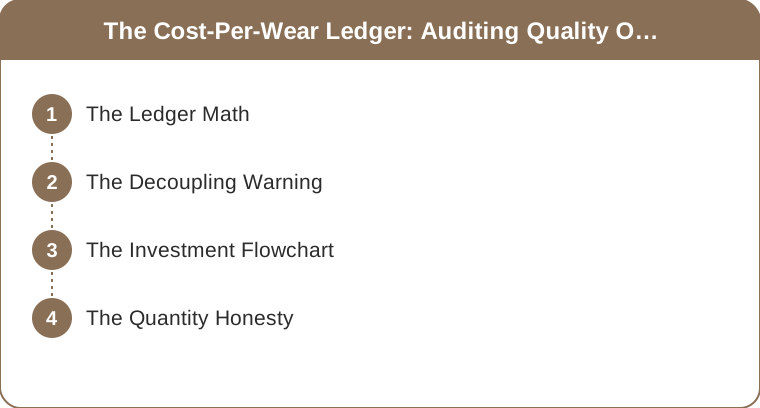
How Do You Run the Cost-Per-Wear Math Honestly?
Price ÷ realistic wears. The word doing the work is realistic.
Worked examples:
- $200 blazer, worn once a week for three years = ~156 wears = $1.28 per wear
- $40 trend top, worn twice = $20.00 per wear
- $350 winter coat, worn 5 days a week for 5 winters = ~500 wears = $0.70 per wear
- $120 occasion dress, worn 3 times = $40.00 per wear
- $90 white sneakers, worn 4 days a week for 18 months = ~310 wears = $0.29 per wear
The cheap piece was the expensive one. That’s not a rhetorical flourish — it’s just the arithmetic.
The discipline is in the wear estimate. Forecast from the life you actually live, not the aspirational one. If you’ve worn heels twice in two years, a beautiful heel is a 3-wear item regardless of how versatile the product page claims it is. Everyone’s estimate is inflated by roughly the same optimism, so halve your first guess.
A useful reframe: anything under about $1 per wear is genuinely cheap, whatever it cost. Anything over $10 per wear is expensive, whatever it cost.
Does a Higher Price Actually Mean Higher Quality?
Not reliably, and this is the audit’s most important finding.
Price and quality came apart somewhere in the last two decades of luxury pricing. A $300 blouse and a $30 one are frequently made of the same polyester, in similar factories, with similar seam finishing. The markup bought branding, retail space, and margin — not necessarily construction.
Quality lives in things you can actually check:
- Fabric composition — read the label. Natural fibers and high-quality blends behave and last differently than 100% cheap polyester
- Seam construction — French seams, flat-felled seams, or at minimum clean overlocking. Puckering along a seam means it will worsen with washing
- Lining — a lined jacket or skirt hangs better and lasts substantially longer
- Hardware — metal zippers over plastic, weighty buttons over hollow ones, a zip that runs smoothly with one hand
- Pattern matching — at the side seams on anything patterned. It signals a factory that isn’t cutting corners
- Fabric weight — hold it up to light. If you can see through a supposedly opaque fabric, you have your answer
Price is a claim. The label and the seams are evidence. Check the evidence.

Which Categories Deserve the Investment Tier?
Three tests. If a piece passes all three, buy the best version you can.
1. Is it high frequency? The daily bag, work trousers, the winter coat, everyday shoes. Uniform pieces earn their price back in months.
2. Is it repairable? A resoleable boot is a different financial object than a glued one. Leather goods, tailored wool, and well-made knitwear can all be maintained for years; fused and glued construction cannot.
3. Is it in the timeless lane? An “investment trend piece” is a contradiction. Trends book the budget tier by definition, because their wear window closes regardless of how well they’re made.
Where to save instead:
- Occasion wear worn once or twice
- Anything trend-driven
- Fast-changing categories like seasonal tops
- Pieces you’re still figuring out whether you like
The output: invest in the workhorses, save on the cameos. That single rule resolves most shopping decisions without any further deliberation.
5 Mistakes Everyone Makes
- Using cost-per-wear to justify a purchase after the fact. The math is a forecasting tool. Run it before you’re standing at the register, not while you’re rationalizing.
- Buying quality without controlling quantity. Quality-buying with no volume discipline just builds an expensive pile. The slogan’s neglected half is the “over quantity” part.
- Assuming a designer label means construction. Turn it inside out. The seams don’t know what the label says.
- Ignoring maintenance costs. A wool coat needs annual dry cleaning; leather boots need resoling. Add those to the ledger, because they’re real.
- Forecasting from aspiration. The wear estimate is where the whole calculation goes wrong, and it goes wrong in the same direction every time.
The second mistake is the one that quietly defeats the whole exercise, because it feels virtuous right up until you count the hangers.
How Do You Actually Buy Less?
The ledger only works with a purchasing constitution attached. Three rules cover most of it:
One in, one out. Every new piece displaces an existing one in the same category. This caps the total without requiring you to count anything.
The 24-hour pause. Nothing unplanned gets bought the same day. Most impulse purchases don’t survive one night of thinking about where they’d actually fit.
Shop from a gap list only. Keep a running note of what’s genuinely missing. If it isn’t on the list, it isn’t a purchase — it’s browsing with a card out.
The endgame is a smaller closet where everything earns its hanger, and the cost-per-wear column trends toward zero on every piece you love. A tightly built capsule wardrobe produces exactly that outcome, because high-frequency items are the ones the math rewards.
FAQ
What’s a good cost-per-wear number to aim for?
Under $1 per wear is genuinely cheap regardless of the sticker price; $1–5 is reasonable for most items; over $10 signals something you’ll wear rarely. Judge the number, not the price tag.
How can I check quality without knowing fabrics well?
Four quick checks cover most of it: read the composition label, look at the inside seams, test the zipper with one hand, and hold the fabric up to light. That takes thirty seconds and catches the majority of poor construction.
Is secondhand a shortcut to the quality tier?
Often the best one available. Leather, cashmere, and tailored wool hold up well and lose most of their price on resale, so the same budget buys a substantially better-constructed piece than it would new.
TL;DR:
- Cost per wear = price ÷ realistic wears. Halve your first wear estimate
- Under $1/wear is cheap, over $10/wear is expensive — regardless of the sticker
- Price stopped predicting quality; check composition, seams, lining, and hardware instead
- Invest where a piece is high-frequency, repairable, and timeless. Save on trends and occasion wear
- Buying quality without a volume rule just builds an expensive pile
- One in one out, a 24-hour pause, and a gap list are what make the ledger work
Divide price by honest wears, verify quality in the seams, invest in workhorses only. The slogan needed a ledger — and kept honestly, the ledger buys better and less, which was always the point of minimalism.
Keep Reading
This article is for general styling and informational purposes only. Trends, sizing, availability and pricing may vary by brand and season.